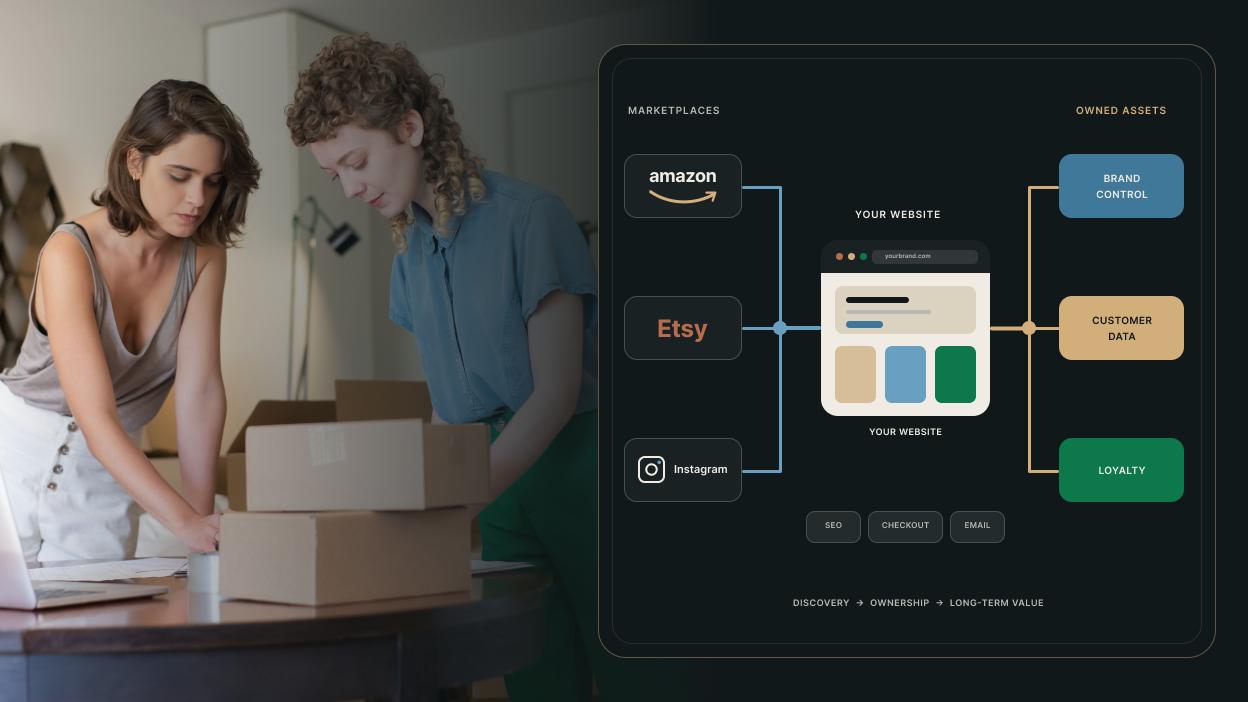
Selling on marketplaces like Amazon, Etsy, or Instagram gives you built-in traffic, but it also means renting space on someone else's platform. An ecommerce website gives you full ownership of your brand, customer data, and revenue. This post explains why serious ecommerce businesses need both, and what to do if your website is broken or missing entirely.
You've done the hard part. You found a product people want, figured out how to source or make it, and built a customer base, largely through Amazon, Etsy, or social media. Sales are coming in. Things look promising.
But here's what most marketplace sellers eventually discover: you don't own any of it. Not the storefront. Not the customer relationship. Not the ability to market freely to your buyers. The moment a marketplace changes its algorithm, raises its fees, or suspends your account, your entire revenue stream is at risk. That's not a hypothetical: Amazon suspends thousands of seller accounts annually, according to Amazon suspension specialist Lesley Hensell writing for Forbes Councils. Amazon does not publish an official annual figure.
This post breaks down the real differences in the marketplace vs ecommerce website debate, answers the questions sellers most commonly ask, and explains why having a professional ecommerce website isn't just a nice-to-have: it's a business-critical asset.
Do I Need My Own Ecommerce Website?
The short answer: yes, especially if marketplaces are currently your primary or only sales channel.
Marketplaces provide reach, trust signals, and built-in traffic. Those are genuine advantages, particularly for new sellers. But they come with structural limitations that become more damaging as your business grows. You generally cannot export marketplace buyers into your own independent email or advertising audiences. Marketplaces may provide limited order or contact information, but sellers generally cannot use it to build independent marketing lists or promote off-platform without permission. You can't control how your brand looks or how products are presented. And every sale comes with a fee attached.
An ecommerce website solves these problems. It gives you a direct line to your customers, full control over the buying experience, and a platform that compounds in value over time through SEO and brand equity. If you're already generating sales through marketplaces, a professional website doesn't replace that. It extends it.
Why Your Business Needs an Ecommerce Website
The case for owning your own website isn't purely defensive. Marketplace listings can generate organic sales, but they remain subject to platform fees, search visibility rules, and optional advertising costs. An ecommerce website, optimized for search, can generate organic traffic month after month. The longer it exists and the more content it accumulates, the more valuable it becomes.
Marketplaces also constrain branding by design. Listings follow a standard format, and storefronts look similar across sellers. A well-designed ecommerce website gives your brand the space to make a real impression through design, copy, imagery, and experience. You also own the customer data you collect directly, enabling email marketing, retargeting campaigns, and loyalty programs that aren't possible through marketplace channels alone.
The Problem with a Broken or Non-Converting Ecommerce Website
Having a website isn't the same as having a website that works.
Many small ecommerce businesses have a website. Technically, it was built years ago, loads slowly, doesn't display correctly on mobile, and hasn't been updated since. A visitor who lands on a broken or outdated site and immediately leaves is a lost sale and a negative brand impression.
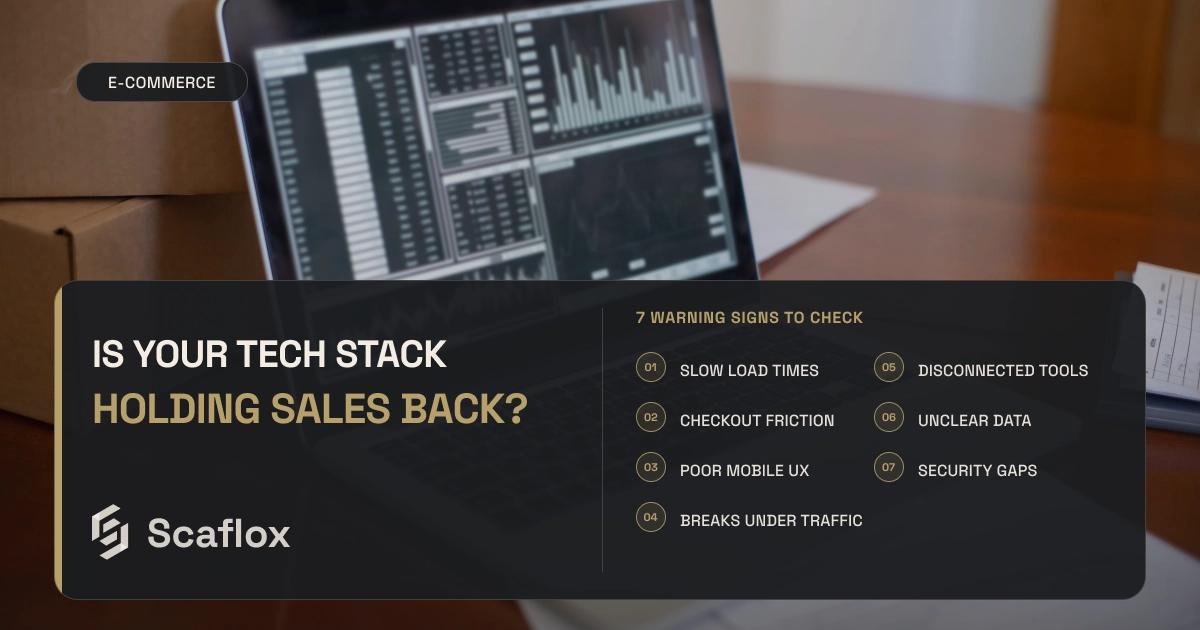
An ecommerce website not converting is one of the most common and costly problems in small business ecommerce. The causes are usually identifiable: poor mobile experience, slow load times, unclear product descriptions, a confusing checkout process, or a lack of trust signals like reviews and secure payment badges.
This is where an ecommerce website redesign becomes a commercial decision, not just an aesthetic one. If your website is currently broken, outdated, or not performing, continuing to drive marketplace traffic to it, or avoiding it entirely, isn't a solution. It's a deferred problem.
Selling on Etsy vs Own Website: What Etsy Sellers Need to Know
Etsy is a compelling platform for independent makers and creative businesses, offering an established audience with built-in trust and payment infrastructure. But selling on Etsy vs owning your own website represents a meaningful strategic difference.
Etsy charges listing fees, transaction fees (currently 6.5% per sale), and payment processing fees. More critically, Etsy controls search visibility. Changes to the platform's algorithm can reduce a shop's exposure overnight. An own ecommerce website lets Etsy sellers build a brand that exists independently of any platform. Many sellers use both marketplace and independent website channels simultaneously: Etsy for discovery, and their own website for returning customers and higher-margin sales.
Amazon Seller Own Website: Why Amazon Sellers Outgrow the Platform
Amazon is the world's largest ecommerce marketplace, and its fulfillment infrastructure, through FBA, has enabled thousands of sellers to scale quickly. But for Amazon sellers, building an own website is increasingly a strategic priority rather than an afterthought.
Amazon charges referral fees that typically range from 8% to 15% depending on product category, plus FBA fees, storage fees, and advertising costs. For competitive categories, total combined costs can reach 30 to 40% of revenue depending on fulfillment method, storage usage, and advertising spend. Selling direct through a professional ecommerce website can meaningfully reduce that cost per sale. Beyond fees, Amazon restricts brand expression and customer communication in ways that limit the brand equity you can build. Your listing sits alongside competitors', often including Amazon's own private-label products.
Sell on Social Media Without a Website: The Hidden Cost
TikTok, Instagram, and Facebook have made it easier than ever to sell through social platforms. TikTok Shop supports direct in-app purchases, allowing buyers to complete a transaction without leaving the app. In the US, operating a Facebook or Instagram Shop requires a website checkout URL. Without one, sellers cannot operate those Shops in the US.
Attempting to sell on social media without a website creates structural problems regardless of the platform. Social commerce is highly impulse-driven. Buyers who want to research a purchase (check reviews, compare variants, understand your returns policy) have nowhere to go if you don't have a website. That friction can reduce the likelihood of completing a sale, particularly for considered purchases.
Social platforms can and do change their algorithms, commerce features, and account policies, sometimes with little notice. A business with no independent web presence is fully exposed to those changes. Social media performs best as a top-of-funnel channel, with a professional ecommerce website capturing and converting that interest into sales.
What Makes a Professional Ecommerce Website
Not every website qualifies as a professional ecommerce website. Mobile traffic accounts for the majority of ecommerce visits globally, so mobile performance is the baseline, not a bonus. Your site should meet Google's Core Web Vitals thresholds: Largest Contentful Paint (LCP) within 2.5 seconds, Interaction to Next Paint (INP) below 200 milliseconds, and Cumulative Layout Shift (CLS) below 0.1. Google uses the mobile version of a website's content for indexing and ranking, while Core Web Vitals are among the signals used by its ranking systems.
- Responsive design: The layout should adapt cleanly to all screen sizes without horizontal scrolling.
- Streamlined checkout: Require as few steps as possible, with support for digital wallets like Apple Pay and Google Pay.
- Readable typography and clear product imagery: Legible on small screens, loading quickly on all devices.
- Trust signals above the fold: Reviews, security badges, and return policies visible early in the browsing experience.
Beyond mobile, a professional ecommerce website needs strong product photography, persuasive copy, a logical site architecture, and technical SEO foundations that support long-term organic visibility.
Ecommerce Website Development for Small Business
Building a professional ecommerce website doesn't require an enterprise budget, but it does require the right expertise. Ecommerce website development for small business is a specialized discipline. The technical requirements (payment gateway integration, inventory management, mobile optimization, SEO configuration, security) go well beyond what drag-and-drop builders handle reliably at scale. Working with experienced developers can lead to meaningful advantages in load speed, conversion performance, and long-term maintainability.
If you're generating meaningful revenue through marketplaces and don't have a professional website, the question isn't whether you can afford to build one. It's whether you can afford not to.
Ecommerce Website Redesign: Is It Time to Upgrade?
If you already have a website but it's not performing, an ecommerce website redesign may be more valuable than any marketing campaign you could run. Signs that your site needs a redesign:
- Your bounce rate is high and time-on-site is low
- Checkout abandonment rates are above industry average (roughly 70%)
- The site isn't mobile-friendly or loads slowly
- Your design looks outdated compared to competitors
- You've added products or features in a piecemeal way that's left the site feeling disorganized
- You're not capturing customer emails or running any retargeting
A redesign done properly is more than a visual refresh. It's a structural overhaul that addresses conversion rate, mobile performance, SEO, and user experience simultaneously. When done well, a redesign can deliver meaningful commercial returns when it addresses the problems affecting sales and customer experience.
Start Building Your Independent Ecommerce Presence
Marketplaces will continue to be a valuable part of the ecommerce ecosystem. Amazon, Etsy, and social commerce platforms aren't going anywhere, and for many sellers, they'll remain important revenue channels. But the businesses that thrive long-term treat marketplaces as a distribution channel, not a foundation.
Your website is your foundation. It's the one digital asset you fully own, the one channel where you control the customer relationship, and the one platform that builds equity over time.
If you're selling on marketplaces but don't have a professional ecommerce website, or if your current site is broken, outdated, or failing to convert, now is the right time to fix that. Get in touch with our team to discuss ecommerce website development for your business. We work with small and growing ecommerce brands to build fast, conversion-optimized websites that work alongside your existing marketplace presence, not instead of it.